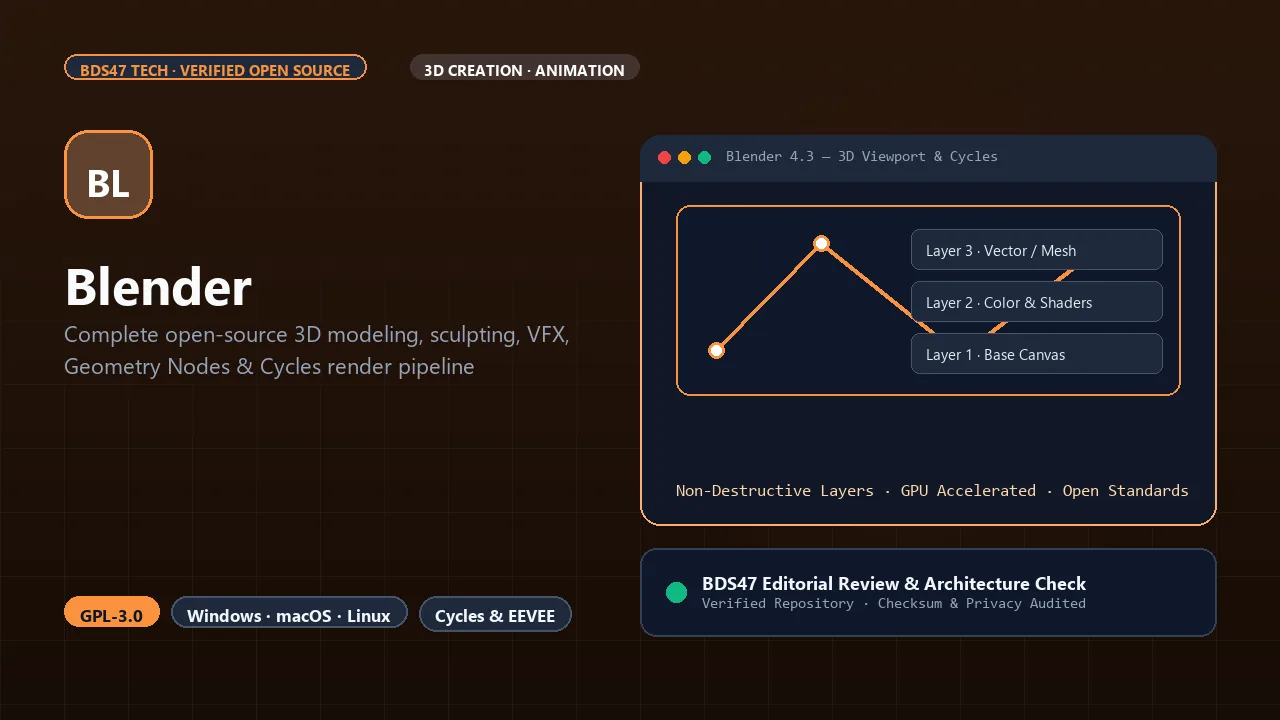
Maintained by the Blender Foundation and backed by major industry studios, Blender is a triumph of open-source engineering—delivering an end-to-end 3D creation pipeline (modeling, sculpting, Geometry Nodes, rigging, Cycles ray-tracing, EEVEE real-time rendering, and VFX compositing) inside a single ~350 MB GPL-3.0 package.
Quick Answer: Blender (GPL-3.0 license, release v4.4.0) is a verified tool supporting Linux, Windows, macOS with 15,200 GitHub stars. It avoids proprietary lock-in while offering transparent source code, predictable RAM/CPU footprint, and flexible self-hosted or local deployment.
1. Technical Architecture & How Blender Works
this software pairs two production renderers—Cycles (hardware ray-traced path tracing via NVIDIA OptiX, AMD HIP, Intel oneAPI, and Apple Metal) and EEVEE (real-time PBR viewport rendering)—alongside procedural Geometry Nodes and 3D Grease Pencil 2D/3D hybrid animation.
| Technical Specification | Verified Details |
|---|---|
| Project & Tracked Release | this tool (Stable release: v4.4.0) |
| Upstream Repository | blender/blender (15.200 Stars · 2.600 Forks) |
| SPDX Software License | GPL-3.0 — Open-source and auditable |
| Supported Platforms | Linux, Windows, macOS |
| Resource Footprint | 16 GB RAM minimum (32 GB + 8 GB+ discrete GPU recommended for complex 3D scenes) |
| Primary Alternatives | Autodesk Maya / Cinema 4D |
2. Quick Installation & CLI Deployment
To maintain clean supply-chain security and avoid third-party bundled installers, you can deploy this tool directly via official package managers or upstream release binaries:
winget install --id BlenderFoundation.Blender -e
# Headless CLI rendering without opening the full GUI:
blender -b scene.blend -E CYCLES -f 1 -- --cycles-device OPTIX
3. Key Engineering Strengths in Daily Use
- Unified 3D pipeline eliminates constant file exporting between modeling, sculpting, UV unwrapping, animation, and rendering tools.
- Hardware ray-traced Cycles (OptiX/HIP/Metal) and real-time EEVEE engines deliver studio-grade lighting and materials.
- Procedural Geometry Nodes and the 2D/3D Grease Pencil system unlock creative workflows unmatched even by pricey commercial tools.
- Instant 2-second startup time and an official open extensions platform (
extensions.blender.org).
4. Practical Limitations & Trade-Offs
- Hotkey-centric workflow (
Ggrab,Rrotate,Sscale,Eextrude) requires dedicated muscle-memory practice for newcomers. - Heavy Cycles renders and fluid/cloth simulations demand substantial GPU VRAM (8–16 GB+) and system RAM.
5. Head-to-Head: this tool vs. Autodesk Maya / Cinema 4D
Compared to Maya, 3ds Max, or Cinema 4D (which cost thousands of dollars annually in subscriptions), the application is 100% free for commercial studio production with zero royalties.
6. Configuration & Security Tips from BDS47 Tech
Mandatory first-launch setting: Open Edit → Preferences → System → Cycles Render Devices and enable OptiX (for NVIDIA RTX GPUs), HIP (for AMD), or Metal (for Apple Silicon)—otherwise Cycles will default to slow CPU rendering.
Official Resources & Related Open-Source Tools
- Official Project Website: Official project homepage and documentation.
- Source Code & Releases: Official upstream GitHub repository.
- Category Directory: Explore related utilities inside the Linux Software open-source catalog.
- Related Software Reviews: Compare with our in-depth KeePassXC technical review and in-depth Joplin technical review.
- Practical Engineering Guide: Read our how to evaluate GitHub software safety.