
While commercial automation platforms such as Zapier and Make impose steep per-execution fees and pose data compliance risks, n8n has established unquestioned leadership in self-hosted workflow automation. With the integration of Native AI Agent Nodes, n8n has evolved from an API orchestration engine into an autonomous business intelligence nerve center.
Quick Answer: n8n (Fair-Code license, release v1.76.0) is a verified tool supporting Docker, Linux, Windows, macOS with 58,500 GitHub stars. It avoids proprietary lock-in while offering transparent source code, predictable RAM/CPU footprint, and flexible self-hosted or local deployment.
With over 58,000 GitHub stars and 400+ pre-built integrations, this tool allows organizations to automate sophisticated multi-step workflows: parsing emails, synthesizing documents, executing database queries, and alerting Slack/Telegram channels without bespoke code.
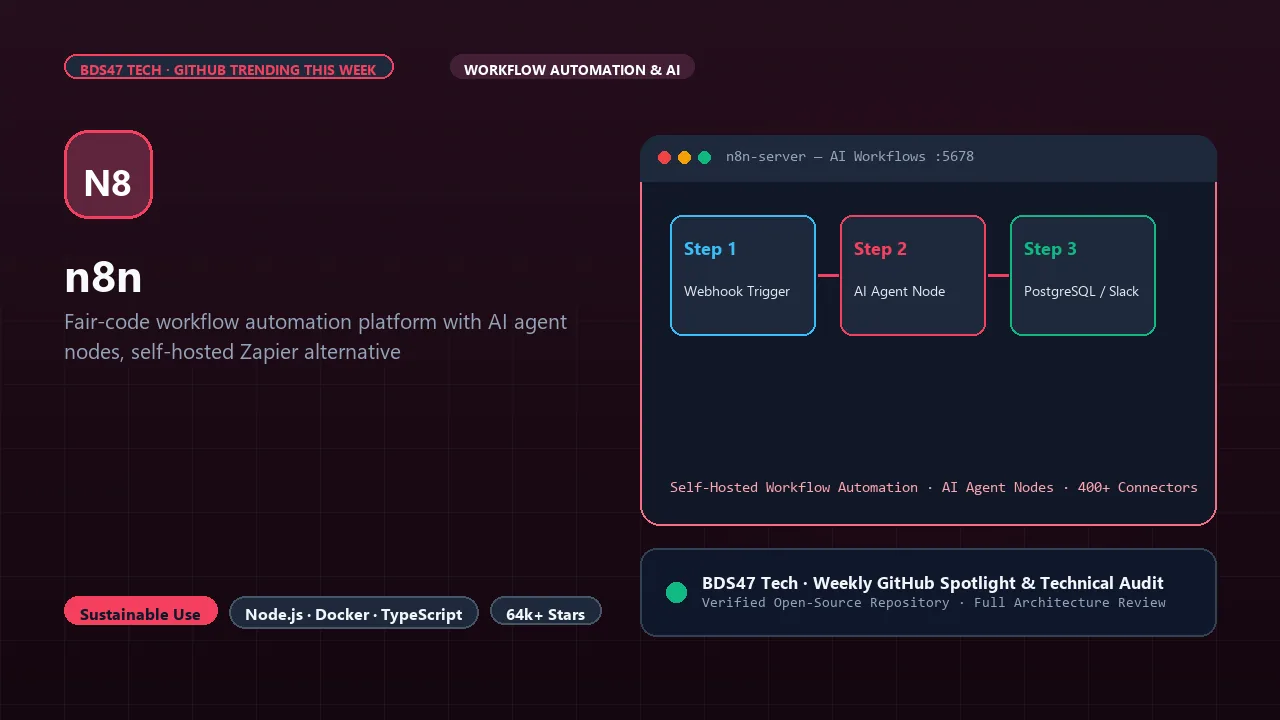
1. The Breakthrough: Connecting AI Agents to 400+ Real-World Integrations
- Native AI Agent Nodes: Powered by LangChain, allowing agents to formulate dynamic plans and select appropriate tool sub-workflows based on incoming payload data.
- Sub-Workflow Tool Calling: Convert any existing this tool workflow into a callable AI tool: querying internal PostgreSQL databases, updating CRM records, or creating invoices.
- Conversational Memory Stores: Retain customer context over multiple conversational sessions using PostgreSQL or Redis memory backends.
- Visual Execution Debugging: Step-by-step telemetry allows engineers to inspect exact JSON inputs, outputs, and intermediate reasoning steps across every node.
2. Production Deployment Guide with PostgreSQL & Docker Compose
services:
  postgres:
    image: postgres:16-alpine
    restart: always
    environment:
      - POSTGRES_USER=this tool
      - POSTGRES_PASSWORD=secure_password_here
      - POSTGRES_DB=this tool
    volumes:
      - ./postgres_data:/var/lib/postgresql/data

n8n:
    image: docker.n8n.io/n8nio/n8n:latest
    restart: always
    ports:
      - "5678:5678"
    environment:
      - DB_TYPE=postgresdb
      - DB_POSTGRESDB_HOST=postgres
      - DB_POSTGRESDB_PORT=5432
      - DB_POSTGRESDB_DATABASE=n8n
      - DB_POSTGRESDB_USER=n8n
      - DB_POSTGRESDB_PASSWORD=secure_password_here
      - N8N_ENFORCE_SETTINGS_FILE_PERMISSIONS=true
    volumes:
      - ./n8n_data:/home/node/.n8n
    depends_on:
      - postgres
3. Comparative Matrix: this tool vs Zapier vs Make (Integromat)
| Metric | this tool (Self-Hosted) | Zapier | Make.com |
|---|---|---|---|
| Hosting Model | Self-Hosted On-Premise | Proprietary Cloud (SaaS) | Proprietary Cloud (SaaS) |
| Execution Cost | Free Unlimited Executions | Expensive tiered billing | Tiered operations billing |
| Data Privacy | 100% Internal Sovereign | Data shared with 3rd-party | Data shared with 3rd-party |
| AI Model Support | Cloud LLMs + Local (Ollama) | Basic proprietary integrations | Cloud AI modules |
4. BDS47 Tech Editorial Verdict
The union of enterprise integration and autonomous AI reasoning makes this software the most powerful operational productivity tool in existence. It provides unmatched ROI for modern digital enterprises.
BDS47 Tech Score: 9.8 / 10 — The premier AI workflow automation engine.
Production Deployment, Security & Backup Best Practices
When moving any self-hosted service or local workspace from initial testing into daily production, isolate the container listener behind a TLS reverse proxy such as Caddy or Nginx rather than exposing raw HTTP ports directly on a public interface. Binding web interfaces to loopback addresses prevents unencrypted credential interception and simplifies automated Let’s Encrypt certificate renewal.
Before upgrading major container tags, stop the running service or trigger an atomic SQLite snapshot so embedded configuration state, user permissions, and historical telemetry remain consistent. Pinning explicit semantic version tags inside Compose manifests prevents unexpected breaking schema migrations when pulling upstream releases, while scheduled off-site volume backups allow full disaster recovery on fresh hardware within minutes.
Finally, monitor resident memory usage under sustained load and configure explicit container restart policies alongside resource limits so background tasks cannot starve co-hosted applications on smaller single-board computers or 1–2 GB virtual private servers.
Official Resources & Related Open-Source Tools
- Official Project Website: Official project homepage and documentation.
- Source Code & Releases: Official upstream GitHub repository.
- Category Directory: Explore related utilities inside the AI & Machine Learning open-source catalog.
- Related Software Reviews: Compare with our in-depth Ollama technical review and in-depth Open WebUI technical review.
- Practical Engineering Guide: Read our technical web architecture and AI guide.


