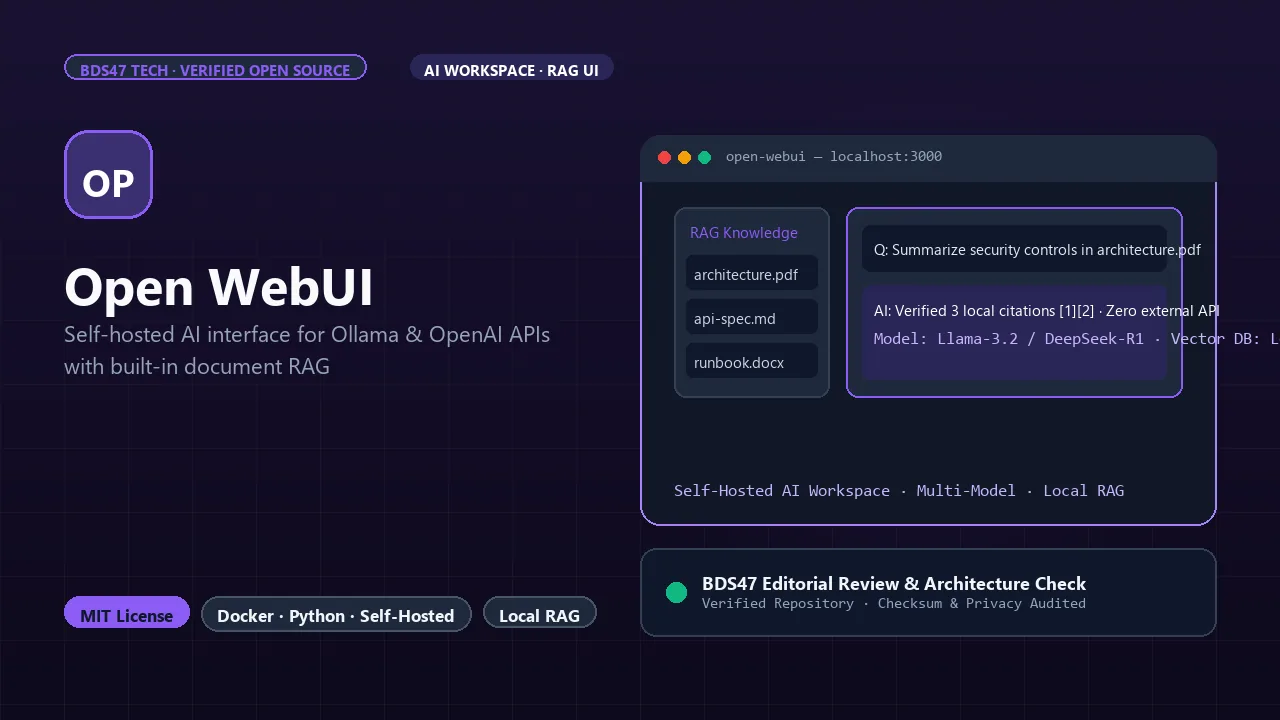
If Ollama is the engine powering local Large Language Models, Open WebUI is the flagship cockpit. It provides a polished, self-hosted web interface that connects seamlessly to local Ollama instances and OpenAI-compatible APIs, complete with built-in document RAG, multi-model side-by-side chat, and multi-user role management.
Quick Answer: Open WebUI (MIT license, release v0.6.5) is a verified tool supporting Docker, Linux, Windows, macOS with 98,400 GitHub stars. It avoids proprietary lock-in while offering transparent source code, predictable RAM/CPU footprint, and flexible self-hosted or local deployment.
1. Technical Architecture & How Open WebUI Works
Built with a FastAPI Python backend and a responsive SvelteKit frontend (installable as a mobile PWA), this software includes an integrated Retrieval-Augmented Generation (RAG) pipeline backed by local vector storage, hybrid BM25 + semantic search, and custom Python Function/Pipelines extensibility.
| Technical Specification | Verified Details |
|---|---|
| Project & Tracked Release | this tool (Stable release: v0.6.5) |
| Upstream Repository | open-webui/open-webui (98.400 Stars · 11.200 Forks) |
| SPDX Software License | MIT — Open-source and auditable |
| Supported Platforms | Docker, Linux, Windows, macOS |
| Resource Footprint | RAM ~600 MB – 1.2 GB (cho container WebUI) · Image Docker ~1.8 GB |
| Primary Alternatives | AnythingLLM / LibreChat |
2. Quick Installation & CLI Deployment
To maintain clean supply-chain security and avoid third-party bundled installers, you can deploy this tool directly via official package managers or upstream release binaries:
docker run -d -p 3000:8080
  --add-host=host.docker.internal:host-gateway
  -v open-webui:/app/backend/data
  --name open-webui --restart always
  ghcr.io/open-webui/open-webui:main
3. Key Engineering Strengths in Daily Use
- Side-by-side multi-model comparison lets you prompt 2–4 local or API models simultaneously and merge their best responses.
- Built-in Document RAG & Knowledge Collections let you index PDFs, Markdown docs, and web URLs via the
#command with inline citations. - Full role-based access control (RBAC), model permission whitelisting, and offline Progressive Web App (PWA) support.
- Extensible via Python Tools & Functions for custom agent workflows, web search, and code execution.
4. Practical Limitations & Trade-Offs
- Requires a running inference backend (such as Ollama, llama.cpp server, or vLLM) to generate responses.
- Default sentence-transformers embedding models inside the container increase initial Docker image size and memory usage unless offloaded to Ollama.
5. Head-to-Head: this tool vs. AnythingLLM / LibreChat
Compared to AnythingLLM Desktop, the application is superior for browser-based multi-device LAN access, side-by-side multi-model prompting, and granular team user permissions.
6. Configuration & Security Tips from BDS47 Tech
Optimization tip: In Admin Panel → Settings → Documents, switch the Embedding Engine to your local Ollama instance using nomic-embed-text or bge-m3 and enable Hybrid Search for much sharper RAG retrieval.
Production Deployment, Security & Backup Best Practices
When moving any self-hosted service or local workspace from initial testing into daily production, isolate the container listener behind a TLS reverse proxy such as Caddy or Nginx rather than exposing raw HTTP ports directly on a public interface. Binding web interfaces to loopback addresses prevents unencrypted credential interception and simplifies automated Let’s Encrypt certificate renewal.
Before upgrading major container tags, stop the running service or trigger an atomic SQLite snapshot so embedded configuration state, user permissions, and historical telemetry remain consistent. Pinning explicit semantic version tags inside Compose manifests prevents unexpected breaking schema migrations when pulling upstream releases, while scheduled off-site volume backups allow full disaster recovery on fresh hardware within minutes.
Finally, monitor resident memory usage under sustained load and configure explicit container restart policies alongside resource limits so background tasks cannot starve co-hosted applications on smaller single-board computers or 1–2 GB virtual private servers.
Official Resources & Related Open-Source Tools
- Official Project Website: Official project homepage and documentation.
- Source Code & Releases: Official upstream GitHub repository.
- Category Directory: Explore related utilities inside the AI & Machine Learning open-source catalog.
- Related Software Reviews: Compare with our in-depth Ollama technical review and in-depth llama.cpp technical review.
- Practical Engineering Guide: Read our Windows Ollama setup and local API guide.