While OpenAI’s original Whisper model established high benchmarks for automatic speech recognition (ASR), deploying it at scale via standard PyTorch pipelines reveals severe bottlenecks: slow inference speeds and high VRAM consumption. To address these limitations, SYSTRAN engineered faster-whisper.
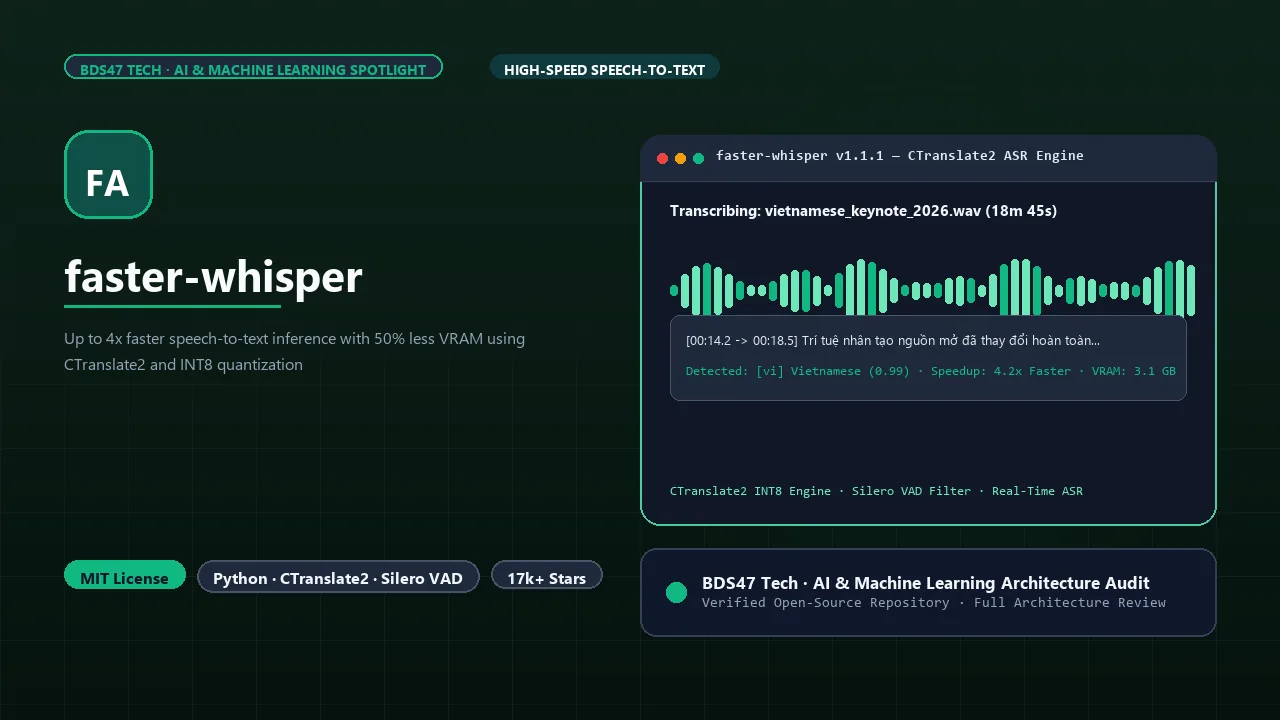
Quick Answer: Faster-Whisper (MIT license, release v1.1.1) is a verified tool supporting Windows, Linux, macOS, Docker with 16,900 GitHub stars. It avoids proprietary lock-in while offering transparent source code, predictable RAM/CPU footprint, and flexible self-hosted or local deployment.
Re-implemented from scratch using the high-performance CTranslate2 engine, this tool achieves up to 4x faster execution while cutting VRAM utilization by over 50% without sacrificing Word Error Rate (WER) accuracy.
1. Technical Innovation: How CTranslate2 Multiplies Whisper Performance
- Custom C++ Transformer Runtime: CTranslate2 replaces heavy PyTorch overhead with fused operators, specialized memory management, and optimized matrix kernels.
- High-Fidelity 8-bit Quantization (INT8 / FP8): Achieves substantial computational speedups and halves memory usage while preserving acoustic fidelity.
- Integrated Silero VAD (Voice Activity Detection): Standard Whisper frequently hallucinates repetitive phrases during prolonged silence. this tool filters silent segments prior to transcription, boosting both throughput and reliability.
2. Benchmark Comparison: this tool vs OpenAI Whisper Baseline
| Model Size | 13-Minute Audio Processing Time | VRAM (this tool INT8) | VRAM (PyTorch Whisper FP16) | Speedup Factor |
|---|---|---|---|---|
| Large-v3 | 17.2 seconds | ~3.1 GB VRAM | ~9.8 GB VRAM | 4.2x Faster |
| Medium | 11.4 seconds | ~1.8 GB VRAM | ~4.9 GB VRAM | 4.1x Faster |
| Small | 6.8 seconds | ~1.0 GB VRAM | ~2.5 GB VRAM | 3.9x Faster |
| Base / Tiny | 2.5 seconds | < 600 MB VRAM | ~1.2 GB VRAM | 3.8x Faster |
3. Python Integration Guide & Automated Subtitle Generation
from faster_whisper import WhisperModel

# Initialize Large-v3 with INT8 quantization on CUDA
model = WhisperModel("large-v3", device="cuda", compute_type="int8_float16")

# Transcribe with automated voice filtering
segments, info = model.transcribe("interview.mp3", beam_size=5, vad_filter=True)

print(f"Detected language: {info.language} ({info.language_probability:.2f})")

for segment in segments:
    print(f"[{segment.start:.2f}s -> {segment.end:.2f}s] {segment.text}")
4. Key Strengths & Production Considerations
Key Strengths:
- Fastest production-grade speech-to-text inference library currently available.
- Accurately transcribes across 99+ languages with punctuation and capitalization formatting.
- Runs efficiently on both entry-level consumer GPUs and headless CPU instances.
- Permissive MIT License encourages commercial deployment and customization.
5. BDS47 Tech Editorial Verdict
this software represents an engineering triumph in model optimization. For speech analytics, podcast transcription, or live captioning systems, it is the undisputed industry standard.
BDS47 Tech Score: 9.6 / 10 — The premier high-performance speech-to-text engine.
Official Resources & Related Open-Source Tools
- Official Project Website: Official project homepage and documentation.
- Source Code & Releases: Official upstream GitHub repository.
- Category Directory: Explore related utilities inside the AI & Machine Learning open-source catalog.
- Related Software Reviews: Compare with our in-depth Ollama technical review and in-depth Open WebUI technical review.
- Practical Engineering Guide: Read our technical web architecture and AI guide.