
The release of DeepSeek-R1 in early 2025 sent shockwaves across the global artificial intelligence landscape. For the first time in AI history, an open-weights model with fully disclosed training methodologies rivaled—and in several mathematical and coding benchmarks outperformed—OpenAI’s proprietary o1 reasoning model, all while requiring an estimated 1/20th to 1/30th of the computational budget of Silicon Valley incumbents.
Quick Answer: DeepSeek-R1 (MIT license, release v1.0) is a verified tool supporting Windows, Linux, macOS, Docker with 78,900 GitHub stars. It avoids proprietary lock-in while offering transparent source code, predictable RAM/CPU footprint, and flexible self-hosted or local deployment.
Beyond the flagship 671-billion-parameter Mixture-of-Experts (671B MoE) architecture, the DeepSeek research team simultaneously open-sourced distilled models ranging from 1.5B, 7B, 8B, 14B, 32B to 70B parameters based on Qwen and Llama architectures. This breakthrough democratizes elite reasoning: developers, engineers, and privacy-conscious enterprises can now run state-of-the-art chain-of-thought AI directly on local workstations and private on-premise infrastructure without external data exposure.
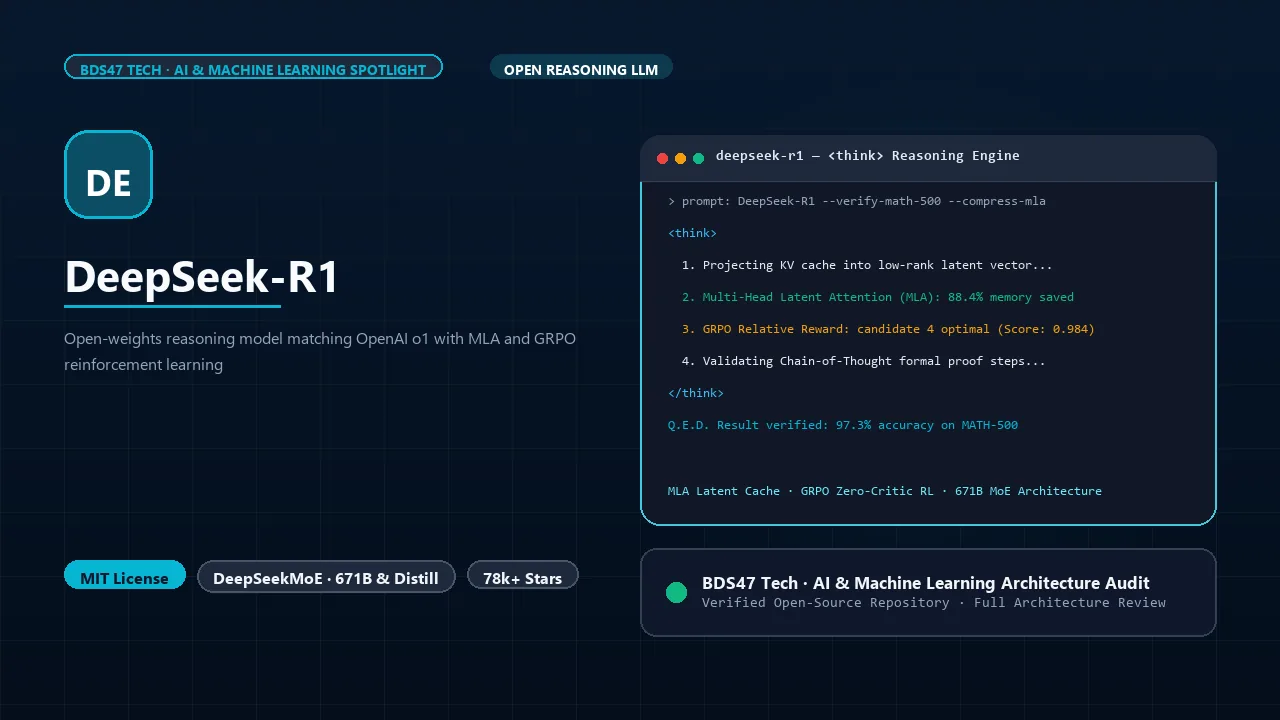
1. Architectural Breakthrough: MLA & GRPO Reinforcement Learning
this software achieves extraordinary computational efficiency through two fundamental architectural breakthroughs:
DeepSeekMoE with Multi-Head Latent Attention (MLA)
Traditional Transformer architectures require massive Key-Value (KV) cache memory buffers that scale linearly with sequence length. MLA projects the KV cache into a low-dimensional latent vector, reducing VRAM footprint by 85% to 90%. This allows models to handle 128k token context windows without running out of memory. Concurrently, the 671B MoE architecture activates only 37B parameters per token, delivering inference speeds comparable to much smaller dense models.
Group Relative Policy Optimization (GRPO)
In traditional reinforcement learning (PPO), a secondary “Critic” model of comparable size is required to evaluate responses, doubling hardware overhead. DeepSeek eliminated the Critic model entirely. GRPO generates a group of candidate outputs for each prompt and calculates relative reward metrics within the group. As a result, the model organically develops multi-step Chain-of-Thought (CoT) reasoning, verification routines, and self-correction without human demonstration bias.
2. Hardware Requirements & Local VRAM Benchmark Matrix
Depending on your available hardware, selecting the right this tool distilled variant ensures optimal throughput and accuracy:
| Model Variant | Base Architecture | Recommended Quant | Min VRAM | Recommended Hardware | Inference Speed |
|---|---|---|---|---|---|
| R1-Distill-Qwen-1.5B | Qwen 2.5 | Q4_K_M / Q8 | 2 GB VRAM | Laptop CPU, Integrated GPU | ~45 – 60 tok/s |
| R1-Distill-Qwen-7B | Qwen 2.5 | Q4_K_M | 6 GB VRAM | RTX 3060 / 4060, M1/M2 Mac | ~30 – 45 tok/s |
| R1-Distill-Qwen-14B | Qwen 2.5 | Q4_K_M | 10 GB VRAM | RTX 3060 12GB / 4070 12GB | ~22 – 35 tok/s |
| R1-Distill-Qwen-32B | Qwen 2.5 | Q4_K_M | 20 GB VRAM | RTX 3090 / 4090 24GB, Mac 32GB | ~15 – 25 tok/s |
| R1-Distill-Llama-70B | Llama 3.3 | Q4_K_M | 42 GB VRAM | 2x RTX 3090/4090 or Mac 64GB | ~10 – 18 tok/s |
| DeepSeek-R1 (Full 671B) | DeepSeekMoE | FP8 / Q4_K_M | 320 GB+ VRAM | 8x H100/A100 or Mac Studio 192GB | ~12 – 20 tok/s |
3. Step-by-Step Installation: Running DeepSeek-R1 Locally with Ollama & vLLM
The most straightforward method to run the application on Windows, Linux, or macOS is through Ollama or vLLM.
Method 1: Instant Local Setup via Ollama (2 Minutes)
If you have Ollama installed, open your terminal or command prompt and execute:
# Run the lightweight 7B model (requires ~6GB RAM/VRAM)
ollama run deepseek-r1:7b

# Run the 14B model - The sweet spot for code and logic (requires ~10GB VRAM)
ollama run deepseek-r1:14b

# Run the powerful 32B model rivaling o1-mini (requires 24GB VRAM GPU or 32GB Mac)
ollama run deepseek-r1:32b
Upon prompting, the model will output its internal reasoning tokens within <think> ... </think> tags before delivering its verified final response.
Method 2: High-Throughput Production Serving via vLLM
For Linux production servers with NVIDIA GPUs, vLLM provides an OpenAI-compatible REST endpoint with continuous batching:
vllm serve deepseek-ai/DeepSeek-R1-Distill-Qwen-14B --tensor-parallel-size 1 --max-model-len 32768 --gpu-memory-utilization 0.9 --port 80004. Core Strengths & Practical Trade-Offs
Key Strengths:
- Elite Mathematical & Algorithmic Capabilities: Achieves 97.3% on MATH-500, competitive with human grandmasters on Codeforces, outperforming previous generation dense models.
- Transparent Chain-of-Thought (CoT): Users can directly inspect hypotheses, counterarguments, and self-corrections within the thought process, dramatically minimizing subtle hallucinations.
- Truly Open MIT License: No restrictive commercial licensing clauses unlike Meta Llama, granting developers full freedom for fine-tuning, integration, and commercialization.
- Rich Distillation Family: The 14B and 32B models run smoothly on consumer GPUs while delivering output quality previously restricted to expensive cloud APIs.
Trade-Offs to Consider:
- Higher Time-to-First-Token (TTFT) compared to non-reasoning models due to the generation of intermediate thinking steps.
- Full 671B model deployment requires enterprise-tier distributed GPU clusters (minimum 8x A100/H100), making distilled variants the practical choice for individual teams.
5. Head-to-Head Comparison: DeepSeek-R1 vs OpenAI o1 vs Qwen 2.5
| Evaluation Metric | DeepSeek-R1 (671B & Distill) | OpenAI o1 | Qwen 2.5 72B Instruct |
|---|---|---|---|
| Source Code & Weights | Fully Open (MIT License) | Closed Proprietary (Cloud API) | Open Weights (Apache 2.0) |
| Local Offline Execution | Yes (Distill 7B – 70B) | No (Cloud Only) | Yes (Requires 48GB VRAM) |
| CoT Visibility | Fully Exposed in <think> tags | Hidden (Summarized only) | No native reasoning CoT |
| API Operating Cost | Extremely Low (~$0.55 / 1M input) | High (~$15.00 / 1M input) | Moderate |
| Enterprise Privacy | 100% On-Premise Air-Gapped | Data Sent to Remote Servers | 100% On-Premise |
6. Frequently Asked Questions (FAQ)
Which DeepSeek-R1 variant is best suited for an RTX 3060 12GB?
The the platform-Distill-Qwen-14B (Q4_K_M quantization) is the optimal match. It utilizes approximately 9.2GB of VRAM, leaving ample room for a 16k context window while generating 25 tokens per second.
Can the <think> tokens be suppressed for instant answers?
If you require immediate conversational responses without reasoning overhead, a standard instruct model such as Qwen 2.5 14B Instruct or Llama 3.3 70B is recommended. The core power of R1 is tied directly to its reasoning steps; bypassing CoT reduces verification accuracy.
7. BDS47 Tech Editorial Verdict
this software is a defining milestone demonstrating that open-weights models can match and surpass proprietary frontier architectures through algorithmic ingenuity. For software engineers, researchers, and enterprises seeking absolute data privacy, this software represents the gold standard reasoning model of 2025.
BDS47 Tech Score: 9.8 / 10 — The premier open-weights reasoning model in artificial intelligence.
Official Resources & Related Open-Source Tools
- Official Project Website: Official project homepage and documentation.
- Source Code & Releases: Official upstream GitHub repository.
- Category Directory: Explore related utilities inside the AI & Machine Learning open-source catalog.
- Related Software Reviews: Compare with our in-depth Ollama technical review and in-depth Open WebUI technical review.
- Practical Engineering Guide: Read our technical web architecture and AI guide.


