OpenMontage has climbed to nearly 82,000 GitHub stars by tackling a problem every creator hits: stitching together five separate AI tools just to finish one video. Instead, it acts as a full agentic production system with 12 structured video pipelines under one roof.
What makes OpenMontage resonate with newcomers and technical builders alike is its director-first workflow. You can paste a reference video or enter a single topic prompt while autonomous agents handle storyboards, provider calls, and timeline assembly inside a unified disk workspace.
1. What is OpenMontage? Beginner Overview & Architecture
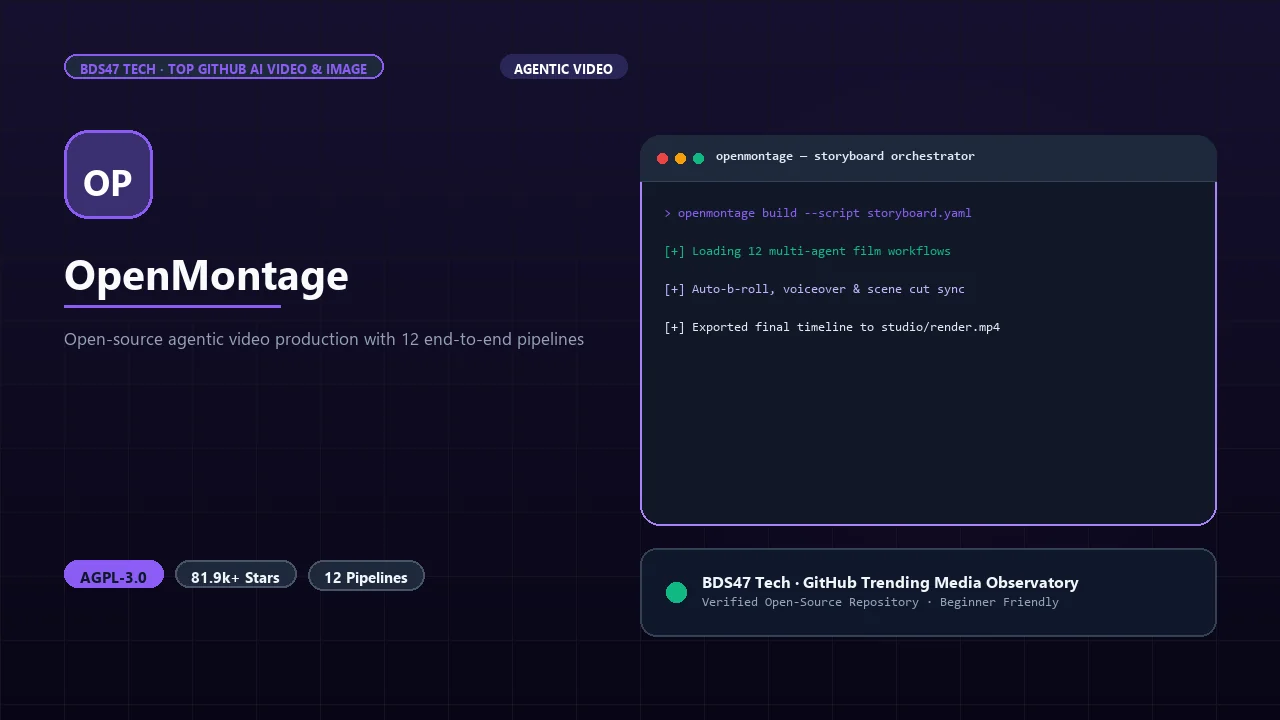
Quick Answer for Beginners: OpenMontage is an open-source (AGPL-3.0) agentic video orchestration engine featuring 12 end-to-end pipelines for explainers, short clips, and reference remakes. It runs on Windows, macOS, and Linux via Python while letting you plug in local models or cloud media APIs.
1.1 Replacing Fragmented AI Tabs With 12 Structured Pipelines
Most beginners start by generating scripts in one chat app, creating visuals in a second site, synthesizing voiceovers in a third, and dragging files into a desktop timeline editor. OpenMontage replaces that manual juggling act with repeatable pipelines tailored for specific video formats.
Each pipeline breaks requests into inspectable intermediate files on disk—story outline, shot list, generated clips, audio tracks, and final render—so nothing stays trapped inside a black box.
1.2 Backlot Dashboard & Modular Provider Architecture
The included Backlot board (python -m backlot open) displays every project stored locally and lets you track production stages visually, review generated shots, and catch script mistakes early.
Through its provider abstraction layer, users can swap between commercial APIs and local open-weight models depending on budget and privacy needs.
2. Hardware & Cost Profiles for Different Setups
Because OpenMontage functions as the orchestrator above media engines and FFmpeg, local GPU demand depends entirely on whether you route heavy generation to cloud APIs or run weights locally.
| Setup Tier | CPU & GPU | RAM & Storage | Provider Mode | Practical Workflow |
|---|---|---|---|---|
| Cloud API Hybrid (Beginners) | Any 4-core laptop CPU | 8 GB RAM · 20 GB disk | Remote LLM + media APIs | Zero GPU strain; pay-as-you-go API cost |
| Balanced Local + API | 8-core CPU + 8–12 GB RTX GPU | 16–32 GB RAM · 80 GB SSD | Local LLM + FFmpeg render | Lower API bills with local scripting |
| Fully Self-Hosted Lab | NVIDIA GPU with 24 GB+ VRAM | 32–64 GB RAM · 200 GB NVMe | Local image & video weights | Complete data privacy inside your network |
Understanding Token Budgets & Intermediate Disk Artifacts
Beginners should pay attention to how multi-step agentic pipelines consume external model credits. Because each stage writes human-readable outlines, shot lists, and prompts to your local disk before invoking video generation backends, stopping to review storyboards in Backlot eliminates wasted GPU or API spend on off-topic scenes.
Whenever possible, assign open local models through Ollama for brainstorming and script pacing while reserving specialized remote endpoints solely for final hero shots or expressive narration tracks.
3. Beginner Setup Guide & First Backlot Launch
Make sure Git, Python 3.11+, and FFmpeg are installed before cloning the repository. On Windows, using WSL2 (Ubuntu) provides smooth support for the included Makefile commands.
Step 1: Clone the Repository and Run make setup
Open your terminal, clone the upstream repository, and execute the setup target so dependencies and environment templates are prepared cleanly.
If ffmpeg -version returns an error inside your shell, install FFmpeg via Homebrew on macOS, apt install ffmpeg on Ubuntu/WSL2, or Winget on Windows before re-running the environment check.
git clone https://github.com/calesthio/OpenMontage.git
cd OpenMontage
make setup
Step 2: Configure Provider Keys and Open the Backlot Library
Add your chosen API keys or local model endpoints inside the environment configuration file, then launch the Backlot board to inspect projects and start a run.
Keep API credentials strictly inside your untracked local environment file rather than hardcoding secrets into custom prompt scripts, especially if you plan to version-control your storyboard templates in Git.
python -m backlot open
# Inspect a specific project timeline:
python -m backlot open <project-id>
4. Four High-Impact Video Use Cases
Structured pipelines unlock repeatable content production workflows that go far beyond single-prompt demo clips.
4.1 Recreating Proven Viral Formats (Paste A Video)
Supply a reference link or clip whose pacing works well, and the system analyzes shot duration, narrative hooks, and transitions before rebuilding an original script around your topic.
4.2 60-Second Technical & Educational Explainers
Turn dense concepts like neural networks or cloud security into concise storyboarded explainers paired with clear visual sequences and synchronized narration.
4.3 Multilingual Brand & Tutorial Localization
With disk-based intermediate assets and community documentation across multiple languages, teams can spin localized adaptations from a single verified storyboard.
4.4 Agent-Assisted Batch Video Production
The built-in Agent Guide empowers coding assistants to run pipelines programmatically, check review notes, and iterate failed scenes automatically.
5. Balanced Pros and Cons
Evaluating both architectural strengths and practical setup trade-offs helps determine whether OpenMontage fits your workflow.
Key Strengths
- End-to-End 12-Pipeline Design: Unifies ideation, storyboarding, asset synthesis, and final FFmpeg assembly.
- Transparent Disk Workspace: Every generated script and scene remains editable through the Backlot board.
- No Single-Vendor Lock-In: Modular Providers documentation supports swapping LLM, TTS, and video backends.
- Massive Open Community: Over 81,000 stars and 11,000 forks driving rapid bug fixes and adapters.
Honest Limitations
- Cloud API Fees Still Apply: While orchestration is free, calling paid video or voice APIs incurs third-party usage charges.
- CLI & Environment Setup Required: Beginners unfamiliar with Python virtual environments or WSL2 face a modest learning curve.
- AGPL-3.0 Copyleft Terms: Modifying the codebase to host a closed commercial SaaS product triggers AGPL source disclosure requirements.
6. Comparing OpenMontage vs MoneyPrinterTurbo and Cloud Studios
See how a multi-pipeline agentic studio compares against a streamlined short-clip tool and proprietary SaaS platforms.
| Criteria | OpenMontage | MoneyPrinterTurbo | Closed SaaS Studios |
|---|---|---|---|
| Workflow Breadth | 12 pipelines + Backlot review board | Single focused vertical-short workflow | Single web timeline & prompt box |
| Software License | AGPL-3.0 Open Source | MIT Open Source | Proprietary subscription ($15–$95+/mo) |
| Beginner Ease | Moderate (Python, Git, Make setup) | Easier (Streamlit WebUI & scripts) | Easiest (instant browser login) |
| Local Customization | High via modular Provider config | High for stock clips & subtitles | Limited to vendor presets |
Teams adopting multi-pipeline automation quickly notice how disk-first storyboards simplify creative review. Unlike single-prompt cloud apps that discard intermediate decisions, keeping structured markdown outlines and audio segments lets editors fix pacing or swap out one weak scene without regenerating the entire production.
For complete beginners testing AI video on a modest laptop without coding setup, starting with focused one-click short tools builds familiarity before graduating to full multi-pipeline orchestration.
7. Beginner Frequently Asked Questions (FAQ)
7.1 Is generating videos completely free once installed?
The orchestration code is free, yet you still supply compute or API keys. Using local models avoids API bills, while cloud video APIs charge per minute or credit consumed.
7.2 How do Windows users run make setup cleanly?
Installing WSL2 with Ubuntu on Windows is the cleanest route because make, Python tooling, and FFmpeg dependencies behave consistently in a Linux shell.
7.3 Can I review and tweak scenes before rendering the final MP4?
Yes. The Backlot interface and project files on disk let you inspect generated scripts and storyboard shots before committing to final video synthesis.
7.4 How does it differ from CapCut or DaVinci Resolve?
Traditional editors wait for you to import footage and cut manually, whereas OpenMontage coordinates AI agents to research, draft, generate, and assemble shots automatically.
8. BDS47 Tech Verdict: Should You Deploy It?
OpenMontage earns a 9.1 / 10 editorial score for turning scattered AI video scripts into an auditable, repeatable 12-pipeline studio architecture. Builders, technical educators, and agencies automating repeatable video series will benefit immediately from its Backlot inspection workflow.
Beginners who start with a single pipeline—such as the 60-second animated explainer template—can observe every generated intermediate file on disk and immediately understand how modern agentic video workflows coordinate scripts, visuals, and audio tracks safely.
If you prefer a simpler one-page browser form specifically built for quick vertical TikTok and Reels shorts, compare it directly with our MoneyPrinterTurbo and Wan2.2 guides linked below.