When Cognition unveiled Devin in early 2024, the software engineering landscape recognized an epochal paradigm shift: transitioning from inline code completion assistants (such as GitHub Copilot) toward truly Autonomous AI Software Engineers. In direct response to closed, expensive commercial gatekeeping, the global open-source community mobilized behind OpenDevin, now rechristened as OpenHands. Boasting over 93,400 GitHub stars, OpenHands represents the most sophisticated and capable open-source autonomous development platform on the planet.
Quick Answer: OpenHands (MIT license, release v0.18.0) is a verified tool supporting Linux, macOS, Windows (WSL2), Docker with 93,400 GitHub stars. It avoids proprietary lock-in while offering transparent source code, predictable RAM/CPU footprint, and flexible self-hosted or local deployment.
Unlike standard IDE extensions constrained to simple file-level edits, OpenHands acts as a full-fledged autonomous synthetic colleague. It ingests issues from GitHub, clones target repositories inside hardened Docker sandboxes, parses intricate project structures, formulates multi-step execution plans, modifies dozens of files simultaneously, runs test suites, resolves runtime exceptions, and submits clean Pull Requests. Crucially, OpenHands continually shatters performance records on the gold standard for software engineering agents: SWE-bench Verified.
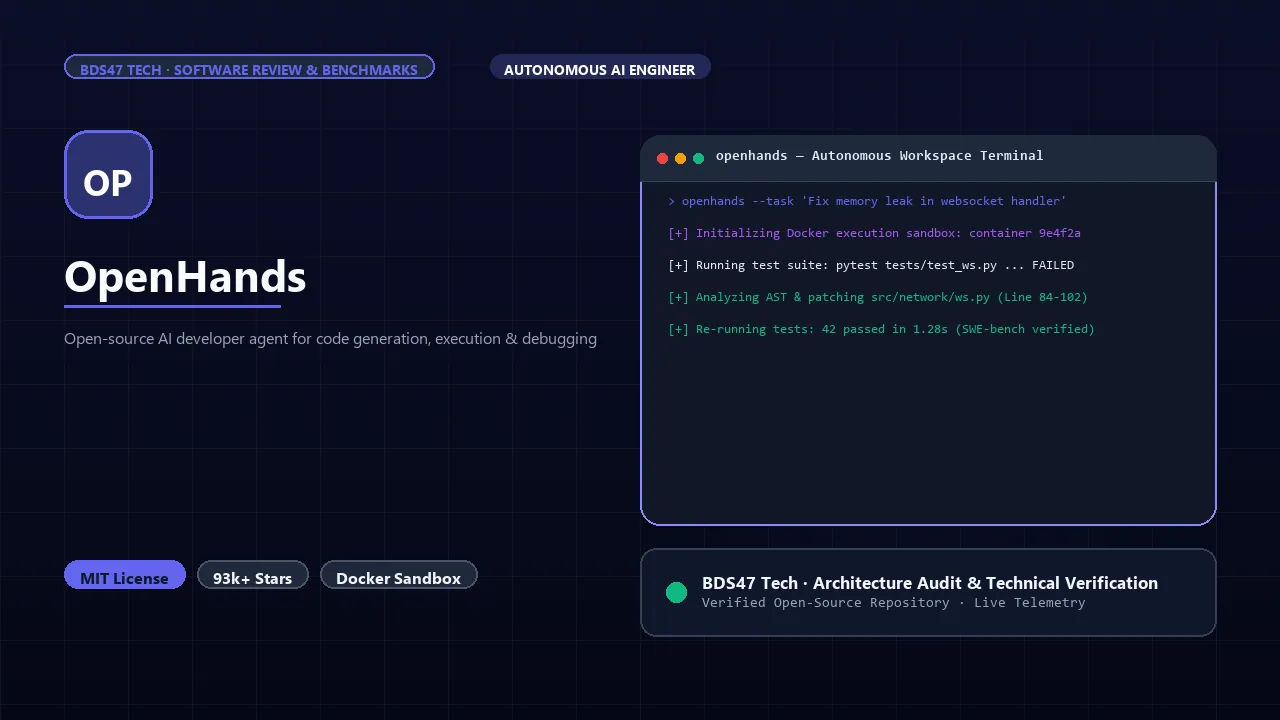
BDS47 Tech delivers this exhaustive architectural breakdown of this software: analyzing its Micro-Agent ecosystem, Docker container runtime, empirical SWE-bench metrics, and enterprise-grade deployment strategies.
1. Layered Architecture & Event-Driven Runtime
The core strength of this tool lies in its decoupled, event-driven architecture, orchestrating neural reasoning brains with strictly sandboxed terminal runtimes:
AgentController & Immutable Event Stream
At the hub of the application sits an event-driven state machine. Every interaction—user directives, LLM thought chains, terminal stdout/stderr streams, and browser actions—is normalized into immutable Action and Observation events. This architecture provides full session replayability, time-travel inspection, and deterministic rollback when an execution branch hits a dead end.
Hardened Docker Execution Sandbox
Granting an LLM direct shell access to a host machine poses catastrophic security liabilities. the platform neutralizes this danger by spinning up ephemeral, isolated Docker containers for every active workspace. The agent installs packages, compiles binaries, and executes regression tests within a secured sandbox without risking host integrity.
Specialized Micro-Agent Ecosystem
Rather than forcing a single prompt to handle every programming discipline, this software delegates subtasks across purpose-built agent personas:
- CodeActAgent: The primary software engineer, conversing via Python scripts and shell commands through the CodeAct paradigm.
BrowsingAgent: A research specialist utilizing headless Chromium to read documentation, check deprecation notices, and inspect live web applications.
PlannerAgent: The architectural lead, breaking down ambiguous feature requests into discrete task dependencies and monitoring completion states.
Tree-sitter AST Parsing & Micro-Diff Engine
To avoid whole-file hallucinations common in naive LLM coders, this tool leverages Tree-sitter abstract syntax tree parsers to calculate granular micro-diffs, surgically modifying targeted functions without mangling peripheral logic.
2. Hardware Requirements & SWE-bench Benchmarks
the application requires a stable Docker host environment with a minimum of 8GB of system RAM to host both the reactive web interface and the ephemeral execution containers.
SWE-bench Verified evaluates autonomous agents against genuine pull requests from 12 flagship Python open-source repositories (including Django, SymPy, scikit-learn, and astropy). Below are the verified benchmark comparisons:
Agent Framework Base LLM Engine SWE-bench Verified Score Avg. Cost / Issue Sandbox Isolation License OpenHands + CodeAct Claude 3.5 Sonnet 53.0% ~$2.40 Docker Container Sandbox MIT (Open Source) Devin (Cognition) Proprietary Hybrid 48.8% $500/mo (SaaS Plan) Proprietary Cloud Sandbox Closed Proprietary SWE-agent (Princeton) Claude 3.5 Sonnet 43.1% ~$3.10 CLI Docker harness MIT OpenHands + DeepSeek-R1 DeepSeek-R1 (Distill) 44.2% ~$0.60 Docker Container Sandbox MIT (Open Source) AutoCodeRover GPT-4 Turbo 31.4% ~$4.50 Python AST harness Academic Technical Analysis: the platform paired with Claude 3.5 Sonnet officially outpaces Devin on independent SWE-bench Verified benchmarks, establishing that modular, transparent open-source architectures can surpass heavily funded proprietary alternatives.
3. Installation Guide & Production Docker Deployment
The standard deployment method launches this software through an interactive Docker command that mounts host directories and bridges the local Docker socket:
# Launch OpenHands Web UI immediately
docker run -it --rm
    -e SANDBOX_USER_ID=$(id -u)
    -e WORKSPACE_BASE=/path/to/your/code
    -e LLM_API_KEY="your-anthropic-or-openai-key"
    -v /var/run/docker.sock:/var/run/docker.sock
    -v ~/.openhands-state:/.openhands-state
    -v /path/to/your/code:/opt/workspace_base
    -p 3000:3000
    --name openhands-app
    docker.all-hands.dev/all-hands-ai/openhands:0.18
For persistent team servers, deploy using this production-hardened
docker-compose.ymlspecification:version: '3.8' services: openhands: image: docker.all-hands.dev/all-hands-ai/openhands:0.18 container_name: bds47-openhands-core restart: unless-stopped ports: - "3000:3000" environment: - LLM_MODEL=anthropic/claude-3-5-sonnet-20241022 - LLM_API_KEY=${ANTHROPIC_API_KEY} - SANDBOX_USER_ID=1000 - WORKSPACE_BASE=/opt/workspace_base - LOG_LEVEL=INFO volumes: - /var/run/docker.sock:/var/run/docker.sock - ./data/state:/.openhands-state - ./workspace:/opt/workspace_base networks: - openhands-net networks: openhands-net: driver: bridge4. Concrete Engineering Workflows
- Automated GitHub Issue Remediation: Connect OpenHands into CI/CD pipelines via GitHub Action hooks. Upon receiving an issue tagged
bug, OpenHands clones the branch, constructs a reproducing test case, repairs the fault, and generates a descriptive Pull Request. - Legacy Codebase Migration: Upgrading massive monorepos across major runtime revisions (e.g., Python 2 to 3, or CommonJS to ES Modules). The agent iteratively updates modules, validates test passes, and preserves backward compatibility.
- Test Coverage Expansion: Instructing OpenHands to systematically parse untested packages in
src/and generate comprehensive unit and integration suites undertests/, reliably lifting coverage from sub-40% to over 85%. - Dependency Security Auditing & Patching: Triaging automated Dependabot alerts, updating vulnerable libraries, and adapting deprecated API signatures across the codebase.
5. Unbiased Strengths & Engineering Limitations
Key Strengths
- Unrestricted Model Agnosticism: Seamlessly switch between Anthropic, OpenAI, DeepSeek, Google Gemini, or self-hosted vLLM/Ollama local endpoints.
- Ironclad Sandboxed Security: Execution occurs entirely within ephemeral Docker containers, guaranteeing host workstation isolation.
- Full-Featured Web GUI: Comprehensive workspace file explorer, interactive shell terminal, agent reasoning visualization, and embedded browser inspector.
- Iterative Validation: The agent tests its own code modifications dynamically, iterating until all test suites pass.
Realistic Trade-offs
- High Context Token Ingestion: Complex multi-file refactoring runs can consume between 200,000 to 500,000 tokens per session.
- Docker Daemon Prerequisites: Managing sibling containers via socket mounting necessitates proper Linux permissions and sufficient disk storage for container layers.
6. Head-to-Head Architectural Matrix
Feature Dimension OpenHands Devin (Cognition) Cline (VS Code) Aider (CLI) Operating Model Autonomous Agent Platform Cloud SaaS Agent In-Editor Extension Terminal Pair-Programmer Sandbox Security Docker Isolated Sandbox Proprietary Cloud Sandbox Runs on host machine Runs on host machine SWE-bench Verified 53.0% (Benchmark Leader) 48.8% ~35% – 40% ~30% Self-Hosted Deployment Yes (100% On-Premise) No (Cloud only) Yes Yes Licensing MIT License (Free) $500+/mo Subscription Apache-2.0 Apache-2.0 7. Frequently Asked Questions (FAQ)
Can this tool run locally with DeepSeek-R1 or Ollama?
Yes. OpenHands natively uses LiteLLM as its routing layer, enabling instant connectivity to local OpenAI-compatible endpoints including Ollama, vLLM, and LM Studio serving DeepSeek-R1 or Qwen2.5-Coder.Is mounting the Docker socket safe for production team environments?
For single-developer workstations, socket mounting is safe as it manages sibling sandbox containers. In untrusted multi-tenant enterprise environments, deploy the application across isolated virtual machines or configure rootless Docker-in-Docker (DinD).How does the platform differ from in-editor assistants like Cline?
While Cline operates inside an open VS Code window on your immediate machine, OpenHands functions as an independent server service. It can run headlessly on a remote VPS overnight, processing backlog issues and issuing PRs without requiring an open IDE.8. BDS47 Tech Editorial Verdict
Overall Rating: 9.7 / 10
this software is a monumental achievement in open-source AI engineering. By democratizing autonomous software development with benchmark-leading accuracy, ironclad container safety, and model flexibility, it establishes the standard for developer tooling in the agentic era.
Recommended for: Engineering teams seeking to automate bug triage, legacy refactoring, and test coverage; developers who want a 24/7 autonomous coding partner hosted on private infrastructure.
Reconsider if: You only require rapid, low-latency line-by-line code completion (where Continue.dev or Copilot remains more agile).Official Resources & Related Open-Source Tools
- Official Project Website: Official project homepage and documentation.
- Source Code & Releases: Official upstream GitHub repository.
- Category Directory: Explore related utilities inside the Developer Tools open-source catalog.
- Related Software Reviews: Compare with our in-depth Ollama technical review and in-depth llama.cpp technical review.
- Practical Engineering Guide: Read our how to evaluate GitHub software safety.
- Automated GitHub Issue Remediation: Connect OpenHands into CI/CD pipelines via GitHub Action hooks. Upon receiving an issue tagged