
While developer frameworks such as LangChain and LlamaIndex demand extensive Python development and frequent debugging in production, Dify has fundamentally transformed how engineering teams deliver generative AI solutions. Boasting over 68,000 GitHub stars, Dify is the world’s leading open-source platform for orchestrating LLM-powered applications, visual multi-agent workflows, and enterprise-grade Retrieval-Augmented Generation (RAG).
Quick Answer: Dify (Apache-2.0 license, release v0.15.3) is a verified tool supporting Docker, Linux, macOS, Windows with 68,500 GitHub stars. It avoids proprietary lock-in while offering transparent source code, predictable RAM/CPU footprint, and flexible self-hosted or local deployment.
1. Architecture Overview: Visual Orchestration Meets Enterprise RAG
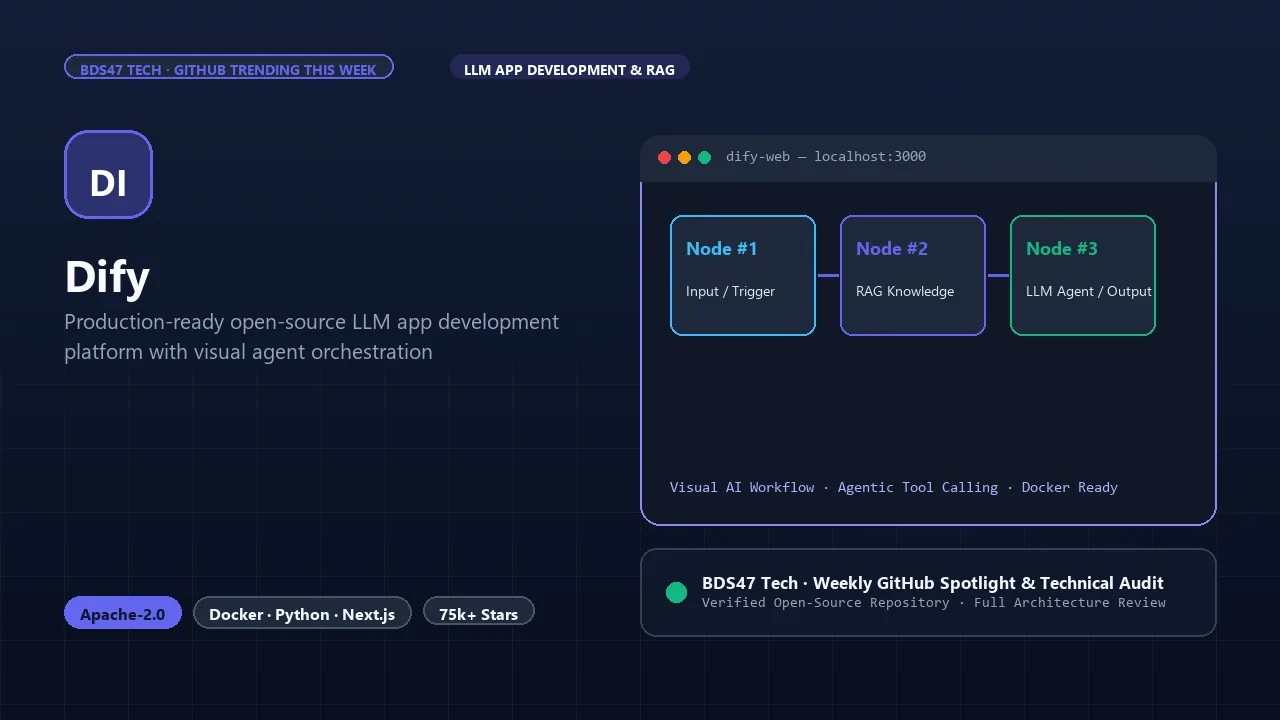
- Visual Workflow Canvas: Enables developers to design complex multi-step pipelines without boilerplate code: from document parsing, external API invocation, branching logic (If/Else), iterative loops, to structured JSON formatting.
- Production-Ready Enterprise RAG: Resolves model hallucinations through hybrid retrieval combining Dense Vector Search with Sparse BM25 keyword matching, integrated with secondary reranking models (Cohere Rerank, BAAI BGE-Reranker) for verified citations.
- Autonomous Multi-Agent Systems: Supports autonomous agents capable of dynamic planning and tool invocation (Google Search, Python code interpreters, SQL execution, custom webhooks).
- Turnkey REST APIs & Embeddable Web Interfaces: Every workflow created on Dify automatically provisions secure, token-authenticated REST APIs and responsive embeddable web chat widgets.
2. Production Deployment via Docker Compose
# Clone official repository
git clone https://github.com/langgenius/dify.git
cd dify/docker

# Copy environment template
cp .env.example .env

# Launch entire production stack
docker compose up -d
Once containers initialize, access http://localhost/install in your browser to configure your primary administrator account.
3. Comparative Breakdown: Dify vs Flowise vs Custom LangChain
| Evaluation Metric | Dify | Flowise | Custom LangChain (Python) |
|---|---|---|---|
| Ease of Use | Very High (Modern UI Suite) | High (Node-RED style graph) | Low (Requires advanced Python) |
| RAG Accuracy | Highest (Built-in Hybrid & Rerank) | Moderate | Dependent on custom code |
| Team & Role Management | Full Multi-Workspace & RBAC | Limited | Requires custom auth system |
| API & WebApp Generation | Instantaneous | Supported | Requires FastAPI / Flask layer |
| License | Apache 2.0 | Apache 2.0 | MIT |
4. Strengths & Operational Considerations
Strengths:
- Reduces generative AI application development lifecycles by up to 80% compared to custom coding.
- Seamlessly bridges cloud foundation models (OpenAI, Claude, Gemini) with private on-premise runtimes (Ollama, vLLM).
- Comprehensive audit logging, latency metrics, and user feedback annotation workflows.
Operational Considerations:
- Multi-container architecture (API, Worker, Redis, PostgreSQL, Vector DB) requires a minimum of 4GB to 8GB server RAM for stable operations.
5. Frequently Asked Questions (FAQ)
Can Dify interface with local Ollama instances?
Yes. Simply configure the Ollama provider within this software’s settings utilizing http://host.docker.internal:11434 on Windows/macOS or the internal LAN IP on Linux.
6. BDS47 Tech Editorial Verdict
this tool successfully bridges conceptual AI research and enterprise production utility. For engineering teams delivering internal knowledge portals or consumer AI applications, Dify is an unmatched open-source foundation.
BDS47 Tech Score: 9.6 / 10 — The premier visual LLM application orchestrator.
Official Resources & Related Open-Source Tools
- Official Project Website: Official project homepage and documentation.
- Source Code & Releases: Official upstream GitHub repository.
- Category Directory: Explore related utilities inside the AI & Machine Learning open-source catalog.
- Related Software Reviews: Compare with our in-depth Ollama technical review and in-depth Open WebUI technical review.
- Practical Engineering Guide: Read our technical web architecture and AI guide.


