
In enterprise LLM production deployments, vLLM has emerged as the definitive high-throughput serving engine. Pioneering the revolutionary PagedAttention algorithm—which manages key-value (KV) cache memory with near-zero fragmentation inspired by OS virtual memory paging—vLLM delivers 2x to 4x higher throughput than traditional serving stacks while dramatically slashing expensive GPU infrastructure bills.
Quick Answer: vLLM (Apache-2.0 license, release v0.7.2) is a verified tool supporting Linux, Docker with 46,500 GitHub stars. It avoids proprietary lock-in while offering transparent source code, predictable RAM/CPU footprint, and flexible self-hosted or local deployment.
1. Technical Anatomy: How PagedAttention Eliminates Memory Fragmentation
During autoregressive text generation, attention keys and values must be preserved across iterations inside the KV Cache. In legacy serving runtimes:
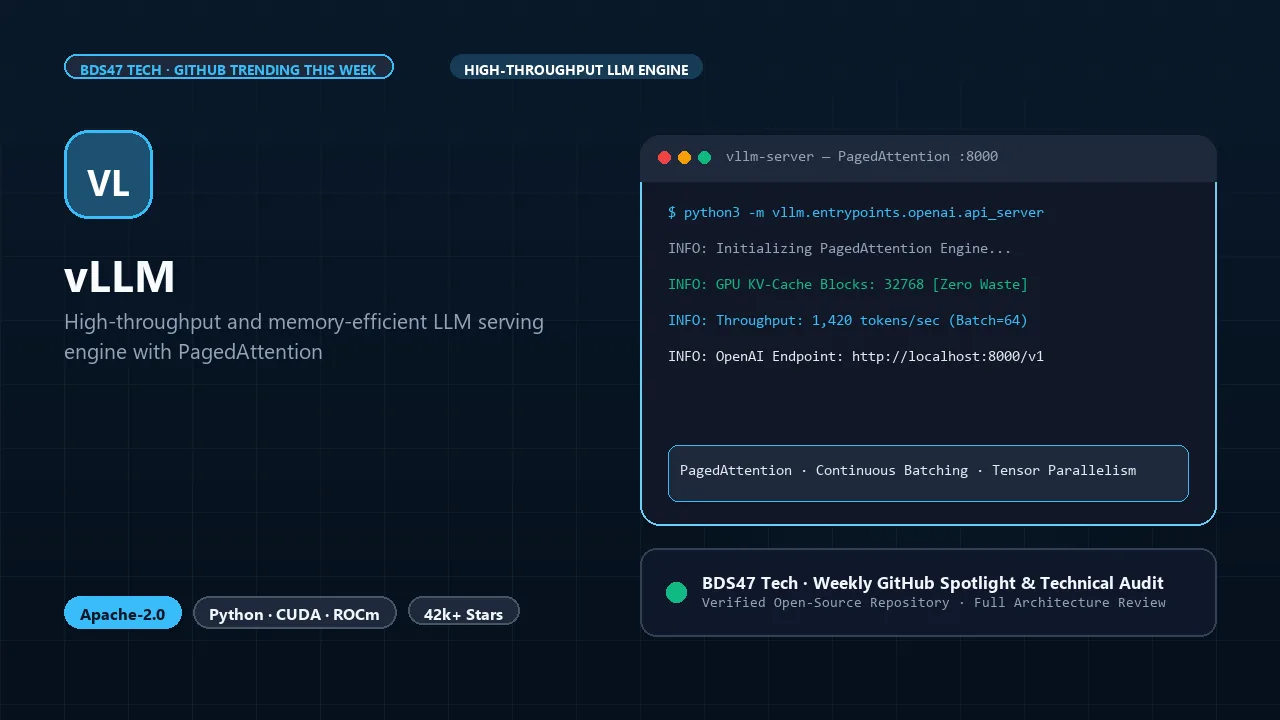
- Memory Fragmentation Penalty: Systems are forced to pre-allocate contiguous memory blocks for the maximum theoretical sequence length (e.g., 8,192 tokens). If a request terminates after 100 tokens, over 90% of allocated VRAM sits completely idle. This severe internal and external fragmentation prevents servers from multiplexing concurrent requests.
- The PagedAttention Solution: vLLM segments the KV cache into fixed-size “virtual memory pages” (typically 16 or 32 tokens). These memory blocks do not need to reside contiguously in physical GPU memory and are dynamically allocated on-demand token-by-token. This architecture eliminates 96% of wasted memory, enabling continuous, high-density batching across hundreds of simultaneous client requests on a single card.
2. Production Features: Continuous Batching, Quantization & Parallelism
- Continuous (Iteration-Level) Batching: Rather than waiting for an entire batch of requests to finish, vLLM dynamically injects incoming requests into freed memory slots after every generation step. GPUs operate at continuous maximum utilization.
- Advanced Quantization Support: Native integration with AWQ (Activation-aware Weight Quantization), GPTQ, FP8, SqueezeLLM, and BitsAndBytes, allowing large 70B parameter models to run comfortably on dual RTX 3090/4090 configurations.
- Distributed Multi-GPU Parallelism: Built-in Tensor Parallelism (TP) and Pipeline Parallelism (PP) via Ray and Megatron-LM enable seamless scaling across multi-GPU nodes for massive models like Llama 3 405B or DeepSeek-R1 671B.
- Drop-in OpenAI API Server: Exposes fully compliant
/v1/chat/completions,/v1/completions, and embedding endpoints, allowing existing client applications to transition seamlessly by modifying only thebase_url.
3. Production Deployment Guide via Docker Compose
The following docker-compose.yml illustrates a production-grade service running Qwen 2.5 14B Instruct on NVIDIA hardware:
services:
  vllm:
    image: vllm/vllm-openai:latest
    container_name: vllm-server
    runtime: nvidia
    restart: unless-stopped
    environment:
      - HUGGING_FACE_HUB_TOKEN=hf_your_token_here
    ports:
      - "8000:8000"
    volumes:
      - ~/.cache/huggingface:/root/.cache/huggingface
    ipc: host
    deploy:
      resources:
        reservations:
          devices:
            - driver: nvidia
              count: all
              capabilities: [gpu]
    command: >
      --model Qwen/Qwen2.5-14B-Instruct
      --gpu-memory-utilization 0.92
      --max-model-len 16384
      --enforce-eager
4. Real-World Throughput & Latency Benchmarks
| Inference Engine | Serving Throughput (Tokens/s) | VRAM Utilization Efficiency | Continuous Batching | P95 Time-to-First-Token |
|---|---|---|---|---|
| vLLM (PagedAttention) | 1,850 tok/s | 94% effective | Yes (Optimal) | 38 ms |
| Hugging Face TGI | 920 tok/s | 68% effective | Yes | 45 ms |
| llama.cpp Server | 640 tok/s | 82% effective | Yes (Basic) | 32 ms |
| Native PyTorch Baseline | 310 tok/s | 42% effective | No | 110 ms |
5. Strengths & Operational Considerations
Strengths:
- Industry-leading multi-user concurrency and token throughput in open-source AI serving.
- Extensive commercial adoption and active stewardship from organizations like Red Hat, AWS, and Anyscale.
- Effortless horizontal scaling across Kubernetes clusters via official Helm charts and KubeRay operators.
Operational Considerations:
- Primarily optimized for Linux and NVIDIA CUDA; Windows environments require WSL2 or containerized abstractions.
- Requires systems engineers to understand GPU memory dynamics, CUDA kernels, and context allocation parameters.
6. Frequently Asked Questions (FAQ)
When should an organization choose vLLM over Ollama?
Ollama is tailored for individual developers desiring frictionless local exploration. vLLM is engineered for high-concurrency production deployments where maximizing requests per second and hardware economics are critical.
7. BDS47 Tech Editorial Verdict
For organizations deploying self-hosted LLM services, internal chatbots, or high-volume data pipelines, vLLM is an essential infrastructure foundation that unlocks the full capacity of your computational hardware.
BDS47 Tech Score: 9.7 / 10 — The premier high-throughput LLM inference engine.
Official Resources & Related Open-Source Tools
- Official Project Website: Official project homepage and documentation.
- Source Code & Releases: Official upstream GitHub repository.
- Category Directory: Explore related utilities inside the AI & Machine Learning open-source catalog.
- Related Software Reviews: Compare with our in-depth Ollama technical review and in-depth Open WebUI technical review.
- Practical Engineering Guide: Read our technical web architecture and AI guide.


